
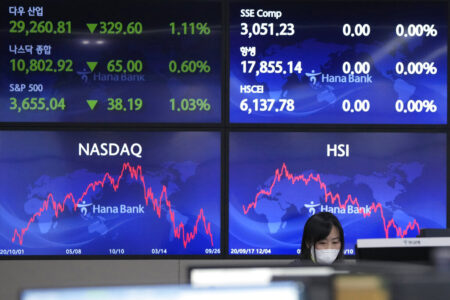
A currency trader watches monitors at the foreign exchange dealing room today of the KEB Hana Bank headquarters in Seoul, South Korea. Stocks were mixed in Asia on today after closing broadly lower on Wall Street, where the Dow Jones Industrial Average fell into what’s known as a bear market. (AP Photo/Ahn Young-joon)
<!–
NEW YORK (AP) — U.S. futures jumped this morning one day after a selloff on Wall Street put the Dow Jones Industrial Average into what’s known as a bear market.
Futures for the Dow Jones Industrial Average climbed 1.2 percent and futures for the S&P 500 were up 1.4 percent. The S&P 500 slid into bear market territory in June.
The end of the third quarter is approaching and with the next round of earnings reports, investors will get a better sense of how companies are dealing with persistent inflation.
Several economic reports are on tap for this week that will give more details on consumer spending, the jobs market and the broader health of the U.S. economy.
The latest consumer confidence report, for September, from the business group The Conference Board will be released this morning. The government will release its weekly report on unemployment benefits on Thursday, along with an updated report on second-quarter gross domestic product.
On Friday, the government will release another report on personal income and spending that will help provide more details on where and how inflation is hurting consumer spending.
Seeking to make borrowing more expensive and crimp spending, the Fed raised its benchmark rate, which affects many consumer and business loans, again last week. It now sits at a range of 3 percent to 3.25 percent. It was near zero at the start of the year. The Fed also released a forecast suggesting its benchmark rate could be 4.4 percent by the year’s end, a full point higher than envisioned in June.
The U.S. economy is already slowing, raising worries that rate hikes might cause a recession. The Dow was the last of the major U.S. stock indexes to fall into what’s known as a bear market on Monday, falling 1.1 percent to 29,260.81.
The Dow is now 20.5 percent below its all-time high set on Jan. 4. A drop of 20 percent or more from a recent peak is what Wall Street calls a bear market.
The S&P 500 fell 1 percent to 3,655.04. The Nasdaq dropped 0.6 percent to 10,802.92, while the Russell 2000 dropped 1.4 percent to close at 1,655.88.
At midday in Europe, Germany’s DAX climbed 0.5 percent and the CAC 40 in Paris rose 0.6 percent. In London, the FTSE 100 was unchanged.
In Asian trading, Tokyo’s Nikkei 225 index picked up 0.5 percent to 26,571.87 and the S&P/ASX 200 added 0.4 percent to 6,496.20. In Seoul, the Kospi rebounded from earlier losses, edging 0.1 percent higher to 2,223.86.
Hong Kong’s Hang Seng added just 5 points, to 17,860.31. The Shanghai Composite index jumped 1.4 percent to 3,093.86 after China’s central bank today moved to maintain cash flow for banks by buying securities from commercial lenders, with an agreement to sell them back in the future.
The official Xinhua News Agency said the People’s Bank of China carried out 175 billion yuan (about $24.7 billion) in reverse repos “to maintain liquidity in the banking system.”
Global stocks have been sagging under concerns over stubbornly hot inflation and the risk that central banks could trigger recessions as they try to cool high prices for everything from food to clothing.
Investors have been particularly focusing on the Federal Reserve and its aggressive interest rate hikes. But volatility in currency markets has further roiled markets.
The British pound dropped to an all-time low against the dollar on Monday and investors continued to dump British government bonds in displeasure over a sweeping tax cut plan announced in London last week. It had stabilized by early today.
The Japanese yen edged toward 145 to the dollar early today. Last week, the Bank of Japan intervened in the market as the yen slipped past 145, gaining a brief reprieve. But the dollar’s surge against other currencies is putting pressure on the BOJ and other central banks, especially in developing economies facing growing costs for repaying foreign loans.
Today, the pound was at $1.0810, up from $1.0686 late Monday. The dollar bought 144.35 yen, down from 144.65 yen, and the euro rose to 96.35 cents from 96.10 cents.
In other trading today, U.S. benchmark crude added 90 cents to $77.61 per barrel in electronic trading on the New York Mercantile Exchange. It sank $2.03 to $76.71 on Monday.
Brent crude, used for pricing international oils, rose 97 cents to $83.83 per barrel.
Techyrack Website stock market day trading and youtube monetization and adsense Approval
Adsense Arbitrage website traffic Get Adsense Approval Google Adsense Earnings Traffic Arbitrage YouTube Monetization YouTube Monetization, Watchtime and Subscribers Ready Monetized Autoblog
from Wall Street Exchange – My Blog https://ift.tt/F9SJc8T
via IFTTT

No comments:
Post a Comment